Ask most Indian households which sweetener is healthiest and the answer is gur. It is unrefined, it is traditional, it carries minerals that white sugar does not. The belief is so settled that few people check it.
On the measure that matters for blood glucose, it does not hold.
**The glycemic numbers**
Jaggery is roughly 65 to 85 percent sucrose — the same molecule as white sugar — with the remainder being invert sugars, moisture, and a small mineral fraction. Published glycemic index values for jaggery sit in the low-to-mid 80s, which is at or above the GI of white table sugar at 65. The processing that leaves the molasses in also leaves the sugar in.
Monk fruit sweetener blended with erythritol has a glycemic index of zero. Mogrosides, the sweet compounds in monk fruit, are not metabolised as carbohydrate, and erythritol is absorbed in the small intestine and excreted largely unchanged in urine. Neither raises blood glucose or triggers an insulin response in the way sucrose does.
For someone managing diabetes, prediabetes or insulin resistance, that is the entire argument. Swapping white sugar for jaggery changes the mineral content of a cup of tea by a rounding error and changes the glucose response by almost nothing.
**Where jaggery genuinely wins**
It would be dishonest to claim jaggery has no merit.
It contains iron, magnesium and potassium that refined sugar does not. The quantities are small relative to daily requirements — you would need to eat an implausible amount of gur to meet your iron needs, and you would consume a great deal of sugar doing it — but they are not zero.
It also behaves differently in cooking. Jaggery brings caramel and molasses notes that a neutral sweetener cannot replicate. In chikki, in gur ki roti, in certain regional sweets, the flavour of jaggery is the point, not just the sweetness. Replacing it in those dishes changes the dish.
And for a person without any glucose concern, eating moderate amounts of traditional food made with jaggery is not a health problem that needs solving.
**The honest comparison**
| | Jaggery | Monk fruit with erythritol |
|---|---|---|
| Glycemic index | Low-to-mid 80s | 0 |
| Calories per teaspoon | About 15 to 16 | 0 |
| Raises blood glucose | Yes | No |
| Trace minerals | Yes, small amounts | No |
| Flavour | Caramel, molasses | Neutral, sugar-like |
| Measures like sugar | Roughly, by weight | Yes, 1:1 |
**What to actually do**
If you are managing blood sugar, treat jaggery the way you treat sugar — because metabolically that is what it is. The common advice to "switch to gur" is one of the more persistent pieces of misinformation in Indian nutrition, and it has let a lot of people believe they made a change when they did not.
If you are cooking something where jaggery's flavour carries the dish, use jaggery and account for it.
For everyday sweetening — chai, coffee, a bowl of kheer, a batch of biscuits — a zero-glycemic sweetener that measures spoon for spoon does the job without the glucose load.
Off Sugar is monk fruit extract blended with erythritol, measured to replace sugar one to one. It will not give you the molasses note of gur. It also will not give you the glucose spike.
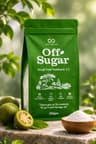
Off Sugar Monk Fruit Sweetener
₹300.00• 250g pouch