India has one of the largest diabetic populations in the world — the ICMR-INDIAB study published in 2023 put the figure above 100 million, with a comparable number living with prediabetes. Which makes "what should I sweeten with" a question tens of millions of households are asking.
Here is the comparison without the marketing.
**Sugar, jaggery and honey**
White sugar has a glycemic index of about 65 and roughly 16 calories per teaspoon.
Jaggery is 65 to 85 percent sucrose, with published GI values in the low-to-mid 80s. It carries trace minerals that refined sugar does not, in quantities too small to matter nutritionally. For blood glucose purposes, treat it as sugar.
Honey has a GI usually cited between 58 and 61 — lower than sugar, but it is still predominantly fructose and glucose, still calorific, and still raises blood glucose. It is not a diabetic sweetener in any meaningful sense.
All three raise blood glucose. For someone managing diabetes, the difference between them is marginal.
**Stevia**
Steviol glycosides are extracted from the stevia leaf, have a glycemic index of zero, and are approved for use in India and internationally.
Their drawback is taste. Many people register a distinct bitter or liquorice-like aftertaste, which varies by which glycosides a particular product is highest in and by individual sensitivity. Stevia is also intensely sweet — 200 to 350 times sugar — so it provides no bulk. A cake needs the volume sugar provides, and stevia alone cannot give it.
**Sucralose and aspartame**
Both are zero glycemic and both are approved by major food safety authorities including the FSSAI.
Sucralose is heat stable enough for most cooking but is a chlorinated compound, which some people prefer to avoid for reasons of preference rather than demonstrated harm at normal intakes. Aspartame is not heat stable and is unsuitable for baking; it must also be avoided by people with phenylketonuria. In 2023 the IARC classified aspartame as possibly carcinogenic to humans, a category that also contains aloe vera extract and pickled vegetables, while the joint FAO/WHO expert committee simultaneously reaffirmed its acceptable daily intake. Both things are true and they are less contradictory than headlines suggested.
**Monk fruit**
Mogrosides from luo han guo have a glycemic index of zero and no calories. Like stevia they are intensely sweet — mogroside V is roughly 250 times sweeter than sucrose — so monk fruit is almost always blended with a bulking agent, most commonly erythritol, to make it measurable.
Taste is where it tends to win. Most people do not report the bitter finish that stevia produces, which is the main reason households that tried stevia and abandoned it often stay with monk fruit.
**The bulking agent question**
This is where sweeteners genuinely differ, and where most marketing gets loud.
Erythritol is a sugar alcohol with a glycemic index of zero. It is absorbed in the small intestine and largely excreted unchanged, which is why it does not ferment in the colon the way other sugar alcohols such as maltitol or sorbitol do, and why it causes far less digestive upset than they do. Very large amounts at once can still unsettle some people.
Products marketed as erythritol-free solve that by selling drops, or by selling a powder several times sweeter than sugar. Both work in a cup of tea. Neither can replace sugar by volume in baking, because the volume sugar provides is doing structural work.
That is the real trade-off, and it is worth stating plainly rather than treating either choice as obviously correct.
**Comparison**
| | GI | Calories/tsp | Bakes 1:1 | Aftertaste |
|---|---|---|---|---|
| White sugar | 65 | 16 | Yes | None |
| Jaggery | 80s | 15-16 | Roughly | Molasses |
| Honey | 58-61 | 21 | No | Floral |
| Stevia | 0 | 0 | No | Often bitter |
| Sucralose | 0 | 0 | Mostly | Mild |
| Monk fruit + erythritol | 0 | 0 | Yes | Usually none |
**What to choose**
If you are managing diabetes and want one sweetener for everyday use, a zero-glycemic option that you will actually keep using is the right answer — and the one you keep using is usually the one that tastes closest to sugar and does not require recalculating recipes.
If you bake, you need bulk, which means a blend rather than drops or a concentrate.
If you have tried stevia and disliked it, the aftertaste you are reacting to is a property of steviol glycosides, not of sweeteners in general. Monk fruit is worth trying before you give up.
And whatever you choose, the sweetener is the smaller half of the problem. Refined flour, portion size and total carbohydrate load move blood glucose more than what goes in your tea.
This is general information, not medical advice. If you are on insulin or glucose-lowering medication, talk to your doctor before changing your diet.
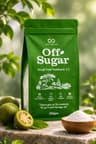
Off Sugar Monk Fruit Sweetener
₹300.00• 250g pouch